Ever since Shawn Stüssy laid the foundations of what came to be known as streetwear with his brand in 1984, the fire of this street revolution has been burning until it has profoundly changed the DNA of a fashion world that was more accustomed to dictating trends than following them. Today, we take a look at four designers whose work has contributed to this evolution: Yohji Yamamoto, Samuel Ross, Jun Takahashi and Teddy Santis.
STÜSSY AND SUPREME: THE RIGHT SPARK
It is impossible to understand the importance and scope of streetwear in today’s fashion world without looking at the two companies that laid the foundations for streetwear to reach the fashion and trend Olympus. The Californian Stüssy in the 80s and the New Yorker Supreme in the 90s were – and still are – the cornerstones of a phenomenon that has spread its tentacles in the world of luxury to the point of completely redefining it.
It all began in 1983, when a very young Shawn Stüssy decided to give his fledgling surfboard brand a boost by printing his signature on T-shirts, caps and other merchandising material. Little did he know that he was laying the foundations for today’s streetwear.

Years later, Stüssy became a fetish brand for members of urban tribes and emerging subcultures (skate, hip hop, punk…), establishing hitherto unknown concepts, such as voluntarily limiting the volume of product on sale – with a consequent increase in demand – and collaborating with other brands, thus producing items that aroused passion among an increasingly devoted public.
It was Stüssy’s collaborator James Jebbia who, after a stint in charge of the New York shop, founded the first Supreme Store on Lafayette Street in 1994. As they say: the rest is history.
Heir to the skateboarding subculture, the company gradually gained notoriety, becoming a cult brand and transcending its initial target audience. After a period of expansion that included openings in Los Angeles, London and various cities in Japan, Supreme began to collaborate with other brands such as Nike, The North Face, Patagonia and Levi’s, increasing its popularity and putting it in the sights of the upper echelons of high fashion.
Her collaboration with Comme Des Garçons in 2012 was a turning point in terms of the relationship between the more or less “traditional” fashion world and street trends, followed by collabs with other brands such as Burberry’s or Tiffany’s, to name but a few. The joint collection with Louis Vuitton in 2017 -which broke resale price records-, and the subsequent purchase of the firm by the French maison’s owner, VF Group, in 2020, only confirmed that luxury streetwear was here to stay.
WHEN THE STREET TAKES OVER THE CATWALK
In the midst of 2022, trends from the neighbourhoods and subcultures born in the 1990s have taken over the catwalks and don’t seem to have much intention of leaving them. From the maximalist sportswear of Denma Gvasalia at Balenciaga or VETEMENTS, to the iconoclastic simplicity of the late Virgil Abloh for Nike, Louis Vuitton Homme or his own label, OFF-WHITE, via the genius of Raf Simmons and his collections for adidas and Fred Perry.
Luxury streetwear has become a juicy business in which new – and not so new – actors play their part, dictating from the street the trends that, season after season, dazzle on the catwalks. At FOOTDISTRICT, we highlight four of the designers who, in our opinion, shine in the task of continuing to shape the world of fashion and trends: Yohji Yamamoto, Samuel Ross, Jun Takahashi and Teddy Santis.
YOHJI YAMAMOTO: Y-3

When in 2003 adidas commissioned the Tokyo designer Yohji Yamamoto to design what would be their first joint collection, adidas Y-3, nothing foretold the earthquake that was to shake the fashion world. The Japanese designer, famous for having created a language of his own, full of organic shapes and impossible designs, was the first to blur the boundaries between sportswear and high fashion.
His luxury tracksuits, his trainers with groundbreaking lines and his accessories and sportswear made of the latest generation of technical fabrics continue today, 15 years later, to be a benchmark for luxury street fashion. A must-have.
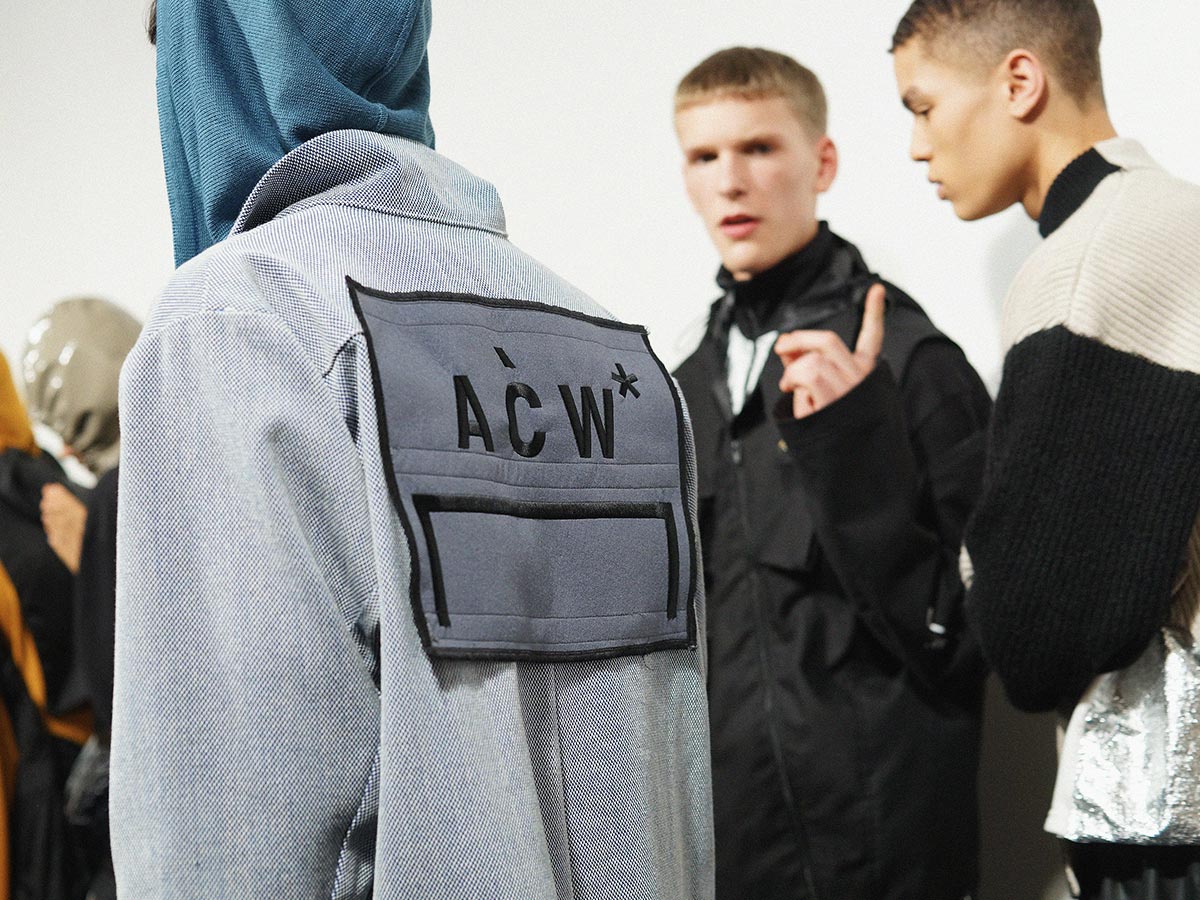
SAMUEL ROSS: A-COLD-WALL*

Strongly influenced by street culture, architecture and design, this native of a poor neighbourhood in Northamptonshire (UK) can boast of having become one of the key players in understanding men’s fashion in the 21st century. A graduate in illustration and graphic arts from De Montfort University, Samuel Ross founded A-COLD-WALL* in 2015 at the age of 29, after having been Virgil Abloh’s right-hand man at OFF-WHITE and after collaborating with Kanye West for his APC collection, Fear Of God and Hood By Air.
Utilitarian and functional minimalism, dignifying the working class and combining impossible materials are the hallmarks of a designer who still has a lot to teach us. And if they are collaborations like his Nike Vomero 5 ACW or his latest creations for Converse, even better.
JUN TAKAHASHI: UNDERCOVER

To understand Jun Takahashi’s unclassifiable and highly personal style, we must first delve into his influences. Born in 1969 in the Japanese city of Kiryu, the designer’s childhood was marked by manga and anime, international fashion magazines and his taste for dressing up in his mother’s clothes. In the 1980s, the punk and alternative rock of the time – Sex Pistols, Patti Smith, The Jesus & Mary Chain – as well as the work of contemporaries such as Yohji Yamamoto, Issey Miyake and, above all, Rei Kawakubo and the Comme Des Garçons boom in Paris in 1981 were the ingredients with which the Japanese “cooked” his brand in 1990.
UNDERCOVER is a disruptive brand, full of transgressive messages, politically charged, punk and gothic influences, and a penchant for fluorescent colours. But in addition, his collaborations with brands such as Uniqlo, Nike (the GYAKUSOU line or the celebrated Nike React Element 87 of 2018) or the most recent accessories collection with Eastpak place the Japanese couturier as one of the heaviestweights in the current industry.
NEW BALANCE/AIMÉ LEON DORÉ BY TEDDY SANTIS

In a very short time, Teddy Santis has established himself as the king of the most elegant and functional streetwear made in NYC. Since this son of Greek immigrants, self-confessed fan of hip hop, Polo Ralph Lauren and true Nike Air Force One fanatic founded Aimé Leon Doré in 2014, his rise in the fashion world has been meteoric. His brand is a love song to the streets of the Big Apple, basketball and 90s rap.
Oversize flannel shirts, premium leather bombers, hoodies and jumpers in soft tones and tailored trousers combined with trainers are his hallmarks. An elegant and classic way of understanding street fashion that has led him to collaborate in capsule collections with Kith, Puma or, more recently, to be appointed creative director of New Balance’s “Made in USA” line, where he is marking a before and after in the international sneaker scene with his particular vision of the legendary 990 series.
Luxury and streetwear have become essential parts of a fashion system that, apparently, works perfectly with the once unusual union. An inexhaustible source of creativity, transgression and rebellion that, for the moment, seems to have no end in sight.